
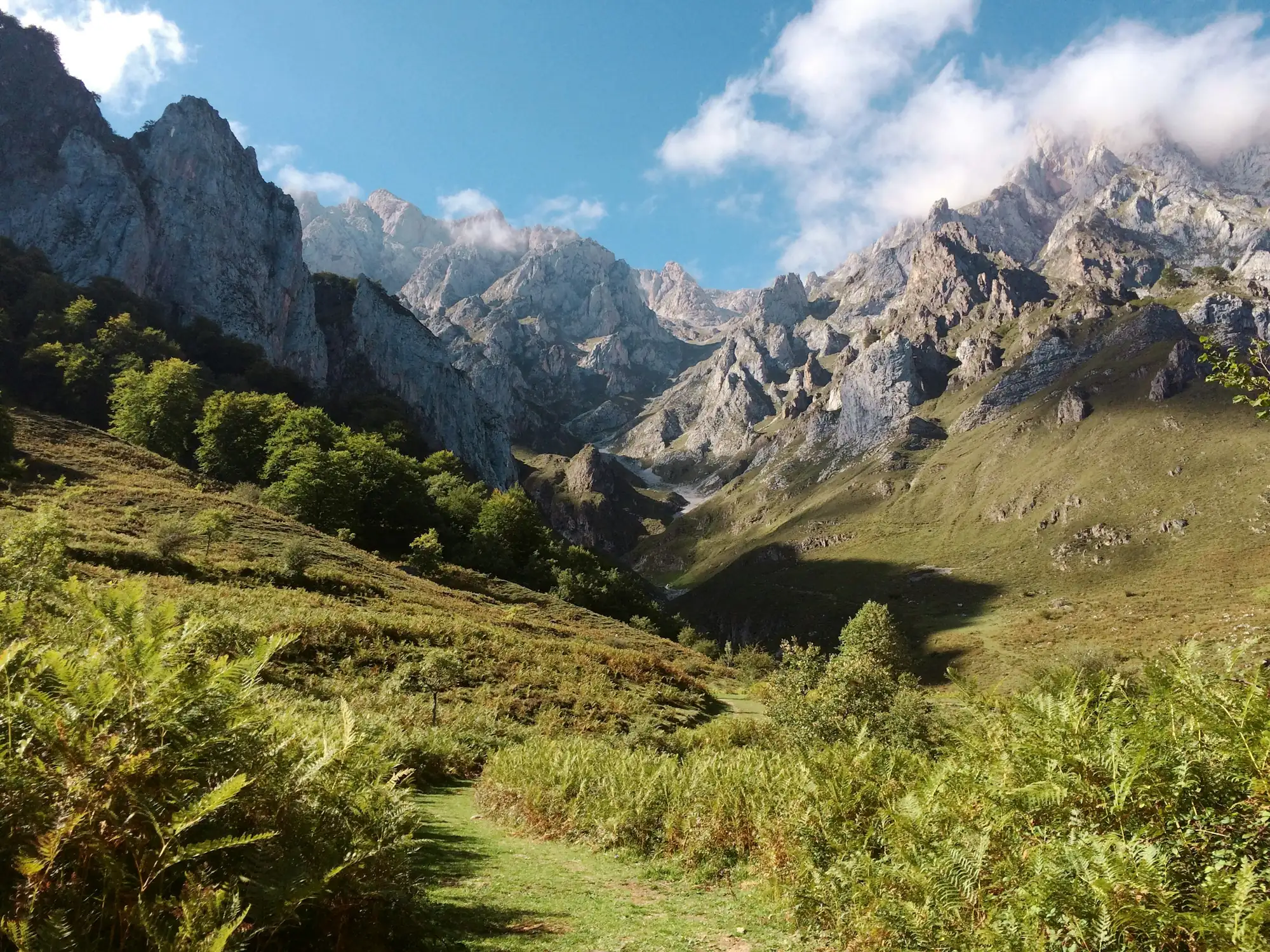
 Photo: Mathew MacQuarrie ↗
THE JOURNEY IN DETAIL
Limestone and sea in one frame.
The Picos de Europa were named by sailors, for whom these limestone walls were the first land of Europe after the Atlantic. The coast is twenty kilometres away and the summits reach 2,650 metres — nowhere else in Europe packs that much relief into so little distance. In a week we walk the Cares gorge, climb to the Naranjo de Bulnes and sleep in refuges at 2,000 metres.
- The Cares gorge, twelve kilometres above the void
- The Naranjo de Bulnes, 2,519 m, up close
- The Covadonga lakes and basilica
- The Bulnes funicular and cabrales cheese caves
With old friends or new ones
Join a group or arrange a separate departure for your own team. Before travelling, we get to know each other, discuss everyone's experience and find suitable dates. You can also prepare together.
DAY BY DAY
Your daily itinerary.
A provisional itinerary. Weather, group readiness and local conditions may change the order and length of the stages.
- DAY 1 · Transfer and a 5 km walk
Oviedo to Arenas de Cabrales
We meet in Oviedo and drive two hours to Arenas de Cabrales at 145 m. An easy evening walk visits the caves where the blue cabrales cheese matures.
Overnight: Hotel in Arenas de Cabrales - DAY 2 · 12 km, 400 m of ascent
The Cares gorge: Cain to Poncebos
The famous Divine Gorge path: twelve kilometres on a ledge cut into the canyon wall, up to three hundred metres above the river. It began as a service track for a 1916 hydro channel.
Overnight: Hotel in Arenas de Cabrales - DAY 3 · 11 km, 1,500 m of climbing
Bulnes and the climb to Urriellu
From Poncebos we walk up to Bulnes at 650 m, a village with no road, reached only by path or funicular. Then 1,300 metres of ascent to the Urriellu refuge beneath the most famous wall in Spain.
Overnight: Refugio de Urriellu, 1,960 m - DAY 4 · 14 km, 500 m of climbing
Around the Naranjo and down to Sotres
In the morning we circle the Naranjo de Bulnes at 2,519 m — the ochre wall changes character every half hour. Then the Jou Gran pass and a long descent through karst basins to Sotres at 1,045 m, the highest village in the massif.
Overnight: Guesthouse in Sotres, 1,045 m - DAY 5 · 9 km, 750 m of ascent
The western massif: Vega de Ario
We transfer to the Covadonga lakes at 1,100 m and climb to the Vega de Ario refuge at 1,630 m. From here the whole depth of the Cares gorge opens, with the eastern massif opposite.
Overnight: Refugio Vega de Ario, 1,630 m - DAY 6 · 13 km, 450 m of ascent
Porra de Enol summit and the lakes
An easy ascent of the Porra de Enol at 1,275 m, with a full circle from the summits to the Bay of Biscay. Down to the Enol and Ercina lakes and a transfer to the valley.
Overnight: Hotel in Cangas de Onis - DAY 7 · 4 km and an 80 km transfer
Covadonga and the road to Oviedo
In the morning we visit the sanctuary of Covadonga, its basilica and the cave where the Reconquista began in the eighth century. In the afternoon we drive back to Oviedo, stopping for a cider lunch.
Overnight: —
Included in the estimated price
Six nights in rural hotels and mountain refuges
Breakfast daily and five dinners
A club guide and a local mountain guide
All transfers on the route and the Bulnes funicular
Bookings at the Urriellu and Vega de Ario refuges
Transfers from and to Oviedo
Not included in the price
Flights to the meeting point
Personal travel insurance and visas
Personal equipment
Single-room supplements and personal expenses
Lunches and two dinners
The Fuente De cable car in free time
Single-room supplement in the hotels
YOUR PREPARATION
Arrive ready for the route.
You need solid fitness for six or seven hours of walking with up to 1,200 metres of gain, and composure on exposed limestone paths. Ivan sets a six-week plan and insists on breaking in stiff-soled boots — karst eats soft footwear.
Prepare with IvanROUTE QUESTIONS
BEFORE WE MEET ON THE TRAIL
What to prepare in advance
- Broken-in trekking footwear and a suitable daypack
- Rain gear, an insulating layer and spare socks
- Poles, if you are used to them
- Personal items within the agreed luggage allowance and suited to the accommodation
Once we choose a date, we agree on the equipment list, meeting point and transfer time. Please wait until the programme is confirmed before booking flights.